A tree’s life story is inscribed in its core. Each year, a new layer of cells forms around the existing wood. It’s thickness and color tell the story of weather and circumstances.
In between the wood and the bark there seems to be nothing at all. Just a line of demarcation finer than the width of a hair. But this is the only place that is alive and growing—wood and bark are not. It is called the cambium, and it is one cell thick. These living cells are undifferentiated—not wood, not bark—but eventually they become both. This imperceptible living layer listens to the cosmos. It pulses with the rhythm of seasons and stars, divides and dies to become water-bearing strength or encircling protection. Again and again, year after year. Death falling continuously out of life.
Hiking in the Redwood forest around my home, I stumble into a circle of trees. I don’t notice this until I am lying on the ground looking up: their slender tips frame a perfectly round patch of blue sky. Then I know: I am lying where a huge Redwood once lived. When an old tree falls or is hewn down, baby trees sprout around the decomposing stump. Life arising continuously out of death. This I learned from trees: death is not an end. It’s merely a challenge: to discover there is no end.
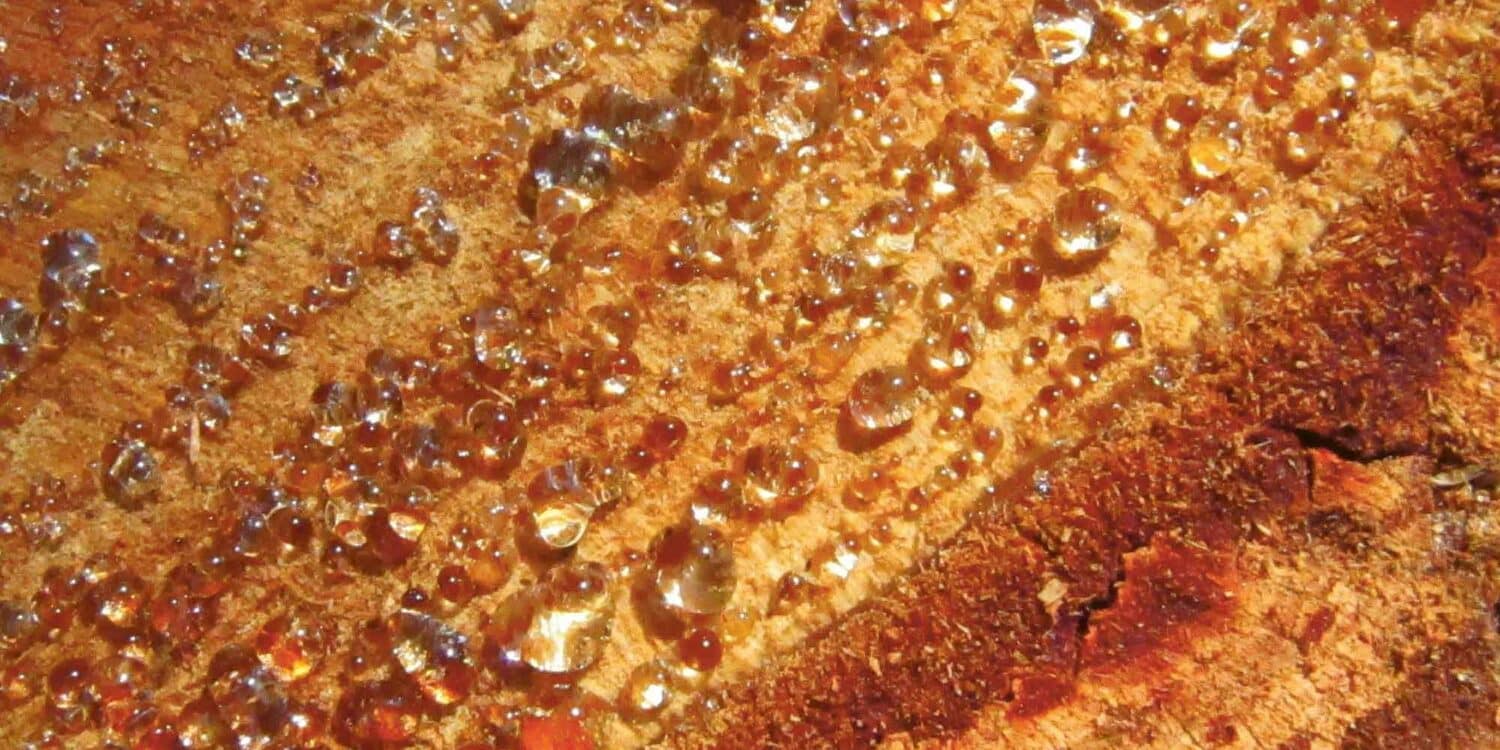
Image Tree sap. Photo: Laura Liska

Laura Liska hat ihr Leben auf verschiedenen Kontinenten verbracht und ist ihrer Liebe zur Sprache und zur Natur durch Wissenschaft, Poesie, Mythen, Fotografie und in ihre Arbeit als Redakteurin nachgegangen. Sie hat einen Abschluss in Computer Sprachen, hat mit der Goetheanistischen Wissenschaft gearbeitet und ist eine zertifizierte Waldtherapie-Führerin.